Harmonia’s Tavern is a UX-driven concept project focused on reimagining the learning experience within Montreat College’s Survey of Musical Styles course. Through research and user feedback, I identified a core issue: students felt overwhelmed by the sheer volume of historical content and disconnected from the material due to its lecture-heavy format. This lack of engagement often resulted in frustration, poor retention, and diminished academic performance, signaling an opportunity to rethink how music history could be taught more interactively.
To better understand the problem, I developed user personas representing contrasting student archetypes—a classically trained pianist and a more laid-back rock guitarist—highlighting shared pain points despite differing musical backgrounds. Empathy mapping revealed common frustrations: information overload, difficulty distinguishing between similar styles and composers, and a general sense of disconnection from the material. These insights informed a refined problem statement centered on improving engagement, comprehension, and emotional connection to the subject matter.
Research Case Study
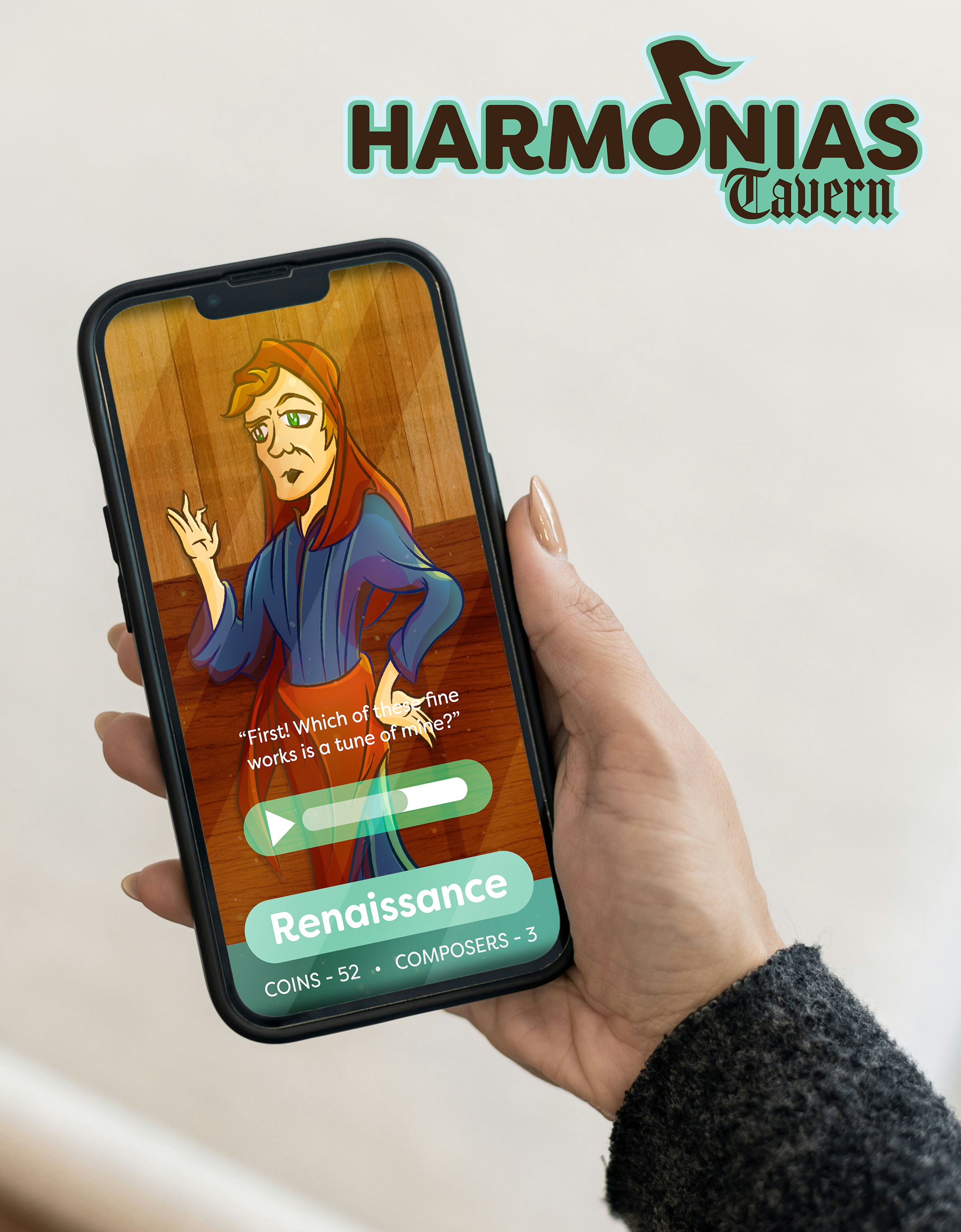
The resulting concept, Harmonia’s Tavern, introduces a role-playing, game-based learning environment where students explore musical history through interactive storytelling. Players assume the role of tavern assistants working for Madame Harmonia, traveling through distinct historical “worlds” that represent different musical eras. By interacting with composer-inspired NPCs, completing tasks, and engaging in music-based challenges, students learn through experience rather than passive memorization. The design emphasizes immersion, narrative, and player agency as tools for reinforcing complex historical and musical concepts.
A low-fidelity prototype, developed in Figma, allowed for early usability testing and iteration. Feedback highlighted key strengths, including stronger emotional connections to composers and improved visualization of historical timelines. However, testing also revealed critical areas for improvement, particularly around information density and clarity of game mechanics. Moving forward, the design focuses on simplifying content delivery, enhancing gameplay clarity, and strengthening the balance between education and engagement—ensuring the experience feels like a game first, and a learning tool second.
LoFi Prototype
HiFi Video Mockup